
An hour at the end of the day - a short story
A familiar path, fading light and one fleeting hour.

This story was born from a daydream last week. Not every story or idea comes so effortlessly, but it’s always fun when it does. My original premise was: what control does a plant have against nature herself and the hands of people? Eventually, it morphed into this wholesome tale.
(video from my balcony garden)
It’s funny how the theme of control features here, especially since my new novel also revolves around that very idea. So perhaps it’s just rattling around in my mind right now. Because this is a short piece, I really focused on every line—trying to make each one not only flow, but also hold some beauty of its own. Hopefully, I’ve achieved something nice, but you’re the ones who’ll decide that.
An hour at the end of the day
Delicate green stems struggle against the gusting summer breeze. Dark wet soil and terracotta pots anchor them to the ground. When September comes they will have withered and died, leaving nothing in their orange pots other than dead roots and depleted earth. It’s the same every year—I’ve always wondered why they’re replanted the following spring, and why the old man who plants them spends his summers caring for them the way he does. But I’ve never gone so far as to ask. After all, those four pots lined up under his kitchen window are his and his alone. We all cling to our own illusion of control, whatever that looks like to us, and it’s cruel to knock it from someone's hands, even if you’re trying to help. I walk past, casting a long shadow behind me as the sun descends. The old man’s four pots are the last remnants of suburbia before I reach the semi-wild greenery of fields and then the truly-wild shadows of the woodland. Long wispy grass brushes against my bare shins as I walk next to sage-green lines of wheat, still a few weeks away from being golden. It’s been a week of sun and storms, push and pull. Under the wispy grass, the ground is cracked from the constant change in weather and I watch my footing, careful not to roll my ankles.
Each day I save myself an hour. That’s my illusion of control. When you start giving yourself an hour it feels as though it’s an irrelevant dot of time. We’ve all spent an hour without thinking about it. In fact, most of us pass our time spending hours without giving them a second thought. As the saying goes, money can’t buy you time. But if all that was really true, we’d all be a bit more precious about our time, don’t you think? But we’re not. Most of us spend it as though it’s the pink and yellow notes from a Monopoly set. And we spend it on nonsense, just this morning I spent forty-five minutes scrolling Facebook posts, gaining nothing other than a new disdain for someone I went to university with, and at least twenty minutes eavesdropping on a couple's argument in a café. Every now and then we spend our time wisely—long drunken dinners with friends, solitary mornings watching the sun rise, afternoons swimming in the sea—and it reminds us of how precious it is.
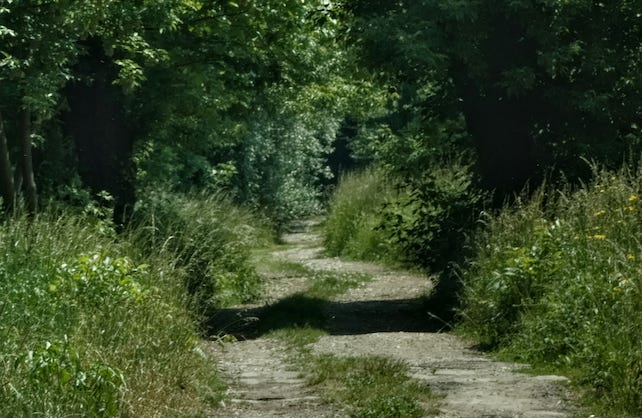
A little further ahead now inside the woodland shadows, there’s a fallen tree, propped against its neighbour. Together they look as though they’re best friends stumbling home from a heavy night. They’re spending their hours wisely. I duck under a branch and leave them behind to continue their journey home. Now the footpath has all but disappeared, badly overgrown by ranks of nettles on either side. I think about turning back, but remind myself this is my hour of control and march forwards. It doesn’t take long for the nettles to lose their sting and a little after that they disappear altogether. Perhaps this far into the woods there’s not enough sunlight for them to grow, or maybe they’ve been eaten by the muntjac deer who dart between the shadows. The breeze picks up again, jasmine and vanilla caught in its grasp. I’m not sure there’s jasmine here, I’m certain there isn’t vanilla.
At the end of the path there’s the beginnings of a stream. When it rains and the breeze dies, you can hear it flow from where I passed the drunken trees. Today though it's the sound of an old man pissing into a pile of leaves. This woodland has a knack of imitating us—with its sounds, scents and shadows—but I’ve never come across anyone since I started walking this way. I suppose there aren’t many people who come to these woods anymore and even fewer who choose to come when the light is fading. Woods like this have a reputation. People lose their minds in places like this or their lives. How many times have we seen drunken trees, overgrown paths and stretched out shadows feature in a person's disappearance. As if the trees themselves bury bodies amongst the lush nettles while the shadows keep watch.
The pissing man’s flow is getting stronger and I know I’m close, the sudden appearance of woodland flowers and long grass giving away the presence of water. Miraculously there is a jasmine bush, its little white flowers in full bloom a few steps away from the water. Through the trees I see the rock I like to sit on when it’s dry enough—positioned in the middle of the pebbled bed the water flows over. I sit there for a while, thinking about nothing, spending my time listening to the water trickle into the night, watching it disappear into shadows.
Before the light completely fades I make my way back, losing my sense of control with each step. Allowing my thoughts to be taken hold of and manoeuvred into new positions by the influences guiding them. First it’s the old man and his garden, then the emails I need to write in the morning and the people I’ve been meaning to call but haven’t gotten around to. Emerging from the densest part of the woods I see the drunk trees again, this time a little closer to home. The wheat field looks turquoise blue—transforming into a coral reef, breathing in the tide of the humid night air. Eventually I reach the four terracotta pots, this time their owner is bent next to them, watering can in hand. His slippers sound like sandpaper against the dusty cobbles as he moves down the line.
‘Hello,’ I say, relinquishing the last piece of control I have left.
‘Good evening. It’s a nice evening for a walk.’
‘It is. Your plants are doing better this year.’
‘They are, aren't they.’ He smiles at his work, ‘But I’ve never been able to get them growing like my wife did.’
‘We can’t all be perfect now, can we,’ I say, watching him drench the last pot. ‘What are they anyway?’ He straightens his spine as much as he can, growing a few inches with the effort.
‘I’m not sure. My wife left a load of seeds in the shed and I just plant some every year.’ He says, shuffling a little closer to me. ‘To tell you the truth. I’m not much of a gardener.’ That much is clear to both of us but I smile at his perseverance or perhaps it’s just out of sympathy.
‘It doesn’t matter. I like to see them grow, no matter how big they get. Anyway, I better be going. It was nice to chat.’
‘Of course. Stop by whenever you like. I see you coming past most evenings.’
‘Every evening actually. And I will. See you tomorrow then.’ I say, crossing the road.
A little about me
I’m a Brit living in the Netherlands. At the moment, I’m reading An Outcast of the Islands by Joseph Conrad (it’s old and bigoted, but also brilliant at times). Murakami is my all-time favourite author (Hard-Boiled Wonderland and the End of the World being my favourite book). And I’m currently growing tomatoes successfully—for once.
Love, Luke
I love to hear from you. Good, bad or ugly your comments are appreciated.
A very beautiful story! I liked the anthropomorphism of nature and the following line a lot: Every now and then we spend our time wisely—long drunken dinners with friends, solitary mornings watching the sun rise, afternoons swimming in the sea—and it reminds us of how precious it is.